Donald Knuth the Art of Computer Programming Vol 4 Pdf
Click here to sign upwards for The Art of Calculator Programming Newsletter, which features updates on new editions and promotions.
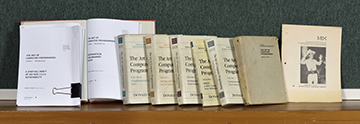
(photo of TAOCP, 1968–2015, by Héctor García-Molina)
At the end of 1999, these books were named amongst the best twelve physical-science monographs of the century by American Scientist, along with: Dirac on quantum mechanics, Einstein on relativity, Mandelbrot on fractals, Pauling on the chemic bond, Russell and Whitehead on foundations of mathematics, von Neumann and Morgenstern on game theory, Wiener on cybernetics, Woodward and Hoffmann on orbital symmetry, Feynman on quantum electrodynamics, Smith on the search for structure, and Einstein'due south collected papers. Wow!
View "celebrated" publisher's brochure from the kickoff edition of Book 1 (1968)
A gratuitous downloadable PDF containing the collected indexes is available from the publisher to registered owners of the four-volume boxed set. This PDF also includes the complete indexes of Volumes 1, ii, iii, and 4A, as well every bit to Book 1 Fascicle i and to Volume 4 Fascicles 5 and 6.
eBook versions
These volumes are now available also in portable electronic course, using PDF format prepared past the experts at Mathematical Sciences Publishers. Special intendance has been taken to make the search feature work well. Thousands of useful "clickable" cross-references are also provided — from exercises to their answers and back, from the index to the text, from the text to important tables and figures, etc.
Alert: Unfortunately, however, not-PDF versions have also appeared, against my recommendations, and those versions are bluntly quite awful. A great bargain of expertise and care is necessary to do the job right. If you lot accept been misled into purchasing one of these inferior versions (for example, a Kindle edition), the publishers accept told me that they will replace your re-create with the PDF edition that I take personally approved. Do not purchase eTAOCP in Kindle format if you expect the mathematics to brand sense. (The ePUB format may be just as bad; I actually don't desire to know, and I am really sorry that it was released.) Delight do not tell me about errors that you find in a non-PDF eBook; such mistakes should be reported directly to the publisher. Some non-PDF versions also masquerade as PDF. You can tell an authorized version because its copyright page (with the exception of Book 4 Fascicle 5) will say 'Electronic version by Mathematical Sciences Publishers (MSP)'.
The authorized PDF versions can exist purchased at www.informit.com/taocp. If y'all have purchased a different version of the eBook, and can provide proof of purchase of that eBook, yous can obtain a complimentary PDF verson by sending email and proof of purchase to taocp@pearson.com.
Book 1
Central Algorithms, Third Edition (Reading, Massachusetts: Addison-Wesley, 1997), xx+650pp. ISBN 0-201-89683-4
Book one Fascicle 1, MMIX: A RISC Calculator for the New Millennium (2005), v+134pp. ISBN 0-201-85392-2
Translations of previous editions:
Romanian translation by Adrian Davidoviciu, Adrian Petrescu, Smaranda Dimitriu, and Paul Zamfirescu, Tratat de programarea calculatoarelor, 5. i: Algoritmi fundamentali (Bucharest: Editura tehnica, 1974), 676pp.
Russian translation by Galina P. Babenko and Iu. M. Baiakovskii, edited by K. I. Babenko, and Five. S. Shtarkman, Iskusstvo programmirovaniia dlia ÉVM, T. one: Osnovnye algoritmy (Moscow: Mir, 1976), 735pp.
Japanese translation, under management of Takakazu Simauti, in two volumes:
- Affiliate ane, by Ken Hirose, Kihon Sampô / Kiso Gainen (Tokyo: Saiensu-Sha, 1978), 22+331pp.;
- Affiliate 2, by Nobuo Yoneda and Katsuhiko Kakehi, Kihon Sampoô / Jôhô Kôzô (Tokyo: Saiensu-Sha, 1978), eight+373pp.
Chinese translation by Guan JiWen and Su Yunlin, Ji Suan Ji Cheng Xu She Ji Ji Qiao, 1. Juan: Ji Ben Suan Fa (Beijing: Defence force Industry Publishing Co., 1980), 14+573pp.
Spanish translation past Michel Antscherl Harlange and Joan Lluis i Biset, under direction of Ramón Puigjaner i Trepat, El Arte de Programar Ordenadores, V. 1: Algoritmos Fundamentales (Barcelona: Reverté, 1980), xxiii+672pp.
Hungarian translation, under direction of Miklós Simonovits, A számítógép-programozás művészete, 5. 1: Alapvető algoritmusok (Budapest: Műszaki Könyvkiadó, 1987), 654pp.
Translations of the third edition:
Russian translation by Southward. Yard. Trigub, Yu. Grand. Gordienko, and I. V. Krasikov, edited by Southward. North. Trigub and directed by Yu. 5. Kozachenko, Iskusstvo programmirovaniia, T. 1: Osnovnye algoritmy (Moscow: Vil'iams, 2000), 713pp; Victor Shtonda's web log about reprints of the Russian translations
Chinese translation by Su Yunlin, Ji Suan Ji Cheng Xu She Ji Yi Shu, 1. Juan: Ji Ben Suan Fa (Beijing: National Defense Industry Printing, 2002), twenty+625pp.
Chinese translation by Li Bomin, Fan Ming, and Jiang Aijun, Ji Suan Ji Cheng Xu She Ji Yi Shu, ane. Juan: Ji Ben Suan Fa (Beijing: Posts & Telecom Press, 2016), fifteen+517pp.
Polish translation by K. Jakacki, Sztuka Programowania, T. 1: Algorytmy Podstawowe (Warsaw: Wydawnictwa Naukowo-Techniczne, 2002), xxiv+679pp.
Romanian translation past Mihaela Târpa, Arta programării calculatoarelor, V. ane: Algoritmi fundamentali (Bucharest: Editura Teora Bucuresti, 2002), 616pp.
Japanese translation past Takashi Aoki, Kazuhiko Kakehi, Kenichi Suzuki, and Takahiro Nagao, supervised by Makoto Arisawa and Eiiti Wada (Tokyo: ASCII Corporation, 2004), xxii+632pp. Republished (softcover) by ASCII DWANGO in 2015.
Korean translation by Ryu Gwang, 컴퓨터 프로그래밍의 예술 1: 기초 알고리즘 (Seoul: Hanbit Media, 2006), 793pp.
German translation past Rüdiger Loos (Heidelberg: Springer Verlag), to appear.
Czech translation by David Krásenský, Umění programování, ane. díl: Základní algoritmy (Brno: Figurer Printing, 2008), xx+649pp.
Macedonian translation past Aristotel Tentov, Umetnosta na kompjuterskoto programiranje, T. ane, Fundamentalni algoritmi (Skopje: Prosvetno Delo, 2009), 724pp.
Albanian translation past Visar Zejnulahu, Arti i programimit kompjuterik, Five. 1, Algoritma fundamentalë (Skopje: Prosvetno Delo, 2009), xx+680pp.
Greek translation by Manos Roumeliotis and Stavros Souraklas (Athens: Tziolas Publications, 2010), 751pp.
Translations of fascicles:
Romanian translation of Volume one Fascicle 1, by Ioan Bledea: MMIX: Un estimator RISC pentru noul mileniu (Bucharest: Editura Teora, 2005), ix+149pp.
Japanese translation of Volume i Fascicle 1, by Takashi Aoki, supervised past Makoto Arisawa and Eiiti Wada (Tokyo: ASCII Corporation, 2006), vii+134pp.
Republished (softcover) past ASCII DWANGO in 2015.
Chinese translation of Volume 1, Fascicle i, by Su Yunlin (Beijing: China Machine Press, 2006), 268pp.
Russian translation of Book 1 Fascicle 1, by Yu. Chiliad. Gordienko, edited by Southward. N. Trigub, MMIX --- RISC-komp'iuter dlia novogo tysiacheletiia (Moscow: Vil'iams, 2007), 151pp.
Smooth translation of Volume 1 Fascicle 1, by One thousand. Jakacki: MMIX --- komputer na nowe tysiąclecie (Warsaw: Wydawnictwa Naukowo-Techniczne, 2008), xii+146pp.
Hungarian translation of Volume 1 Fascicle 1, under the management of Antal Iványi: MMIX. RISC számítógép a következő évezredre (Budapest: AnTonCom Infokommunikációs Kft., 2009), 168pp.
Book two
Seminumerical Algorithms, Third Edition (Reading, Massachusetts: Addison-Wesley, 1997), xiv+762pp.
ISBN 0-201-89684-two
Translations of previous editions:
Russian translation past Galina P. Babenko, É. M. Belaga, and L. V. Maiorov, edited past K. I. Babenko, Iskusstvo programmirovaniia dlia ÉVM, T. two: Poluchislennye algoritmy (Moscow: Mir, 1977), 724pp.
Japanese translation, nether management of Takakazu Simauti, in two volumes:
- Affiliate 3, by Masaaki Sibuya, Jun Suchi Sampô / Ransû (Tokyo: Saiensu-Sha, 1982), 2+259pp.;
- Affiliate 4, past Keisuke Nakagawa, Jun Suchi Sampô / Sanjutsu Enzan (Tokyo: Saiensu-Sha, 1986), xii+536pp.
Romanian translation by Florian Petrescu, Ioan Georgescu, Rolanda Predescu, and Paul Zamfirescu, Tratat de programarea calculatoarelor, V. ii: Algoritmi seminumerici (Bucharest: Editura tehnica, 1983), 722pp.
Chinese translation past Guan JiWen and Su Yunlin, Ji Suan Ji Cheng Xu She Ji Ji Qiao, ii. Juan: Ban Shu Zhi Suan Fa (Beijing: Defense Industry Publishing Co., 1992), ten+622pp.
Hungarian translation, under direction of Miklós Simonovits, A számítógép-programozás művészete, V. 2: Szeminumerikus algoritmusok (Budapest: Műszaki Könyvkiadó, 1987), 690pp.
Translations of the 3rd edition:
Russian translation by L. F. Kozachenko, 5. T. Tertyshnyi, and I. Five. Krasikov, edited past Southward. N. Trigub and directed by Yu. V. Kozachenko, Iskusstvo programmirovaniia, T. 2: Poluchislennye algoritmy (Moscow: Vil'iams, 2000), 830pp.
German translation of Chapter four past Rüdiger Loos Arithmetik (Heidelberg: Springer Verlag, 2001), xiii+538pp.
Chinese translation by Su Yunlin, Ji Suan Ji Cheng Xu She Ji Yi Shu, 2. Juan: Ban Shu Zhi Suan Fa (Beijing: National Defence force Industry Printing, 2002), xii+760pp.
Chinese translation by Wu Bin and Fan Ming, Ji Suan Ji Cheng Xu She Ji Yi Shu, 2. Juan: Ban Shu Zhi Suan Fa (Beijing: Posts & Telecom Press, 2016), x+603pp.
Romanian translation by Mihaela Târpa, Cora Radulian, and Mihai Iosif, Arta programării calculatoarelor, 5. 2: Algoritmi seminumerici (Bucharest: Editura Teora Bucuresti, 2002), 663pp.
Polish translation by Adam Malinowski, Sztuka Programowania, T. 2: Algorytmy Seminumeryczne (Warsaw: Wydawnictwa Naukowo-Techniczne, 2002), xviii+820pp.
Japanese translation by Hiroaki Saito, Takahiro Nagao, Shogo Matsui, Takao Matsui, and Hitoshi Yamauchi, supervised by Makoto Arisawa and Eiiti Wada (Tokyo: ASCII Corporation, 2004), xvi+725pp. Republished (softcover) by ASCII DWANGO in 2015.
Korean translation by Ryu Gwang, 컴퓨터 프로그래밍의 예술 2: 준수치적 알고리즘 (Seoul: Hanbit Media, 2007), 933pp.
Greek translation by Manos Roumeliotis and Stavros Souraklas (Athens: Tziolas Publications, 2010), 911pp.
Czech translation by David Krásenský, Umění programování, 2. díl: Seminumerické algoritmy (Brno: Calculator Printing, 2010), xii+763pp.
Volume 3
Sorting and Searching, Second Edition (Reading, Massachusetts: Addison-Wesley, 1998), xiv+780pp.+foldout.
ISBN 0-201-89685-0
Translations of the kickoff edition:
Romanian translation past Rodica Boconcios, A. Davidoviciu, P. Dimo, Fl. Moraru, A. Petrescu, I. Sipos, and Smaranda Dimitriu, Tratat de programarea calculatoarelor, V. 3: Sortare şi căutare (Bucharest: Editura tehnica, 1976), xii+736pp.
Russian translation by Nadezhda I. V'iukova, V. A. Galatenko, and A. B. Khodulev, edited by Iu. M. Baiakovskii and Five. Due south. Shtarkman, Iskusstvo programmirovaniia dlia ÉVM, T. three: Sortirovka i poisk (Moscow: Mir, 1978), 844pp.
Chinese translation past Guan JiWen and Su Yunlin, Ji Suan Ji Cheng Xu She Ji Ji Qiao, 3. Juan: Pai Xu He Cha Zhao (Beijing: Defense force Industry Publishing Co., 1985), viii+645pp.
Spanish translation by Jaime de Argila y de Chopitea and Ramón Puigjaner Trepat, under management of Ramón Puigjaner Trepat, El Arte de Programar Ordenadores, V. iii: Clasificación y Búsqueda (Barcelona: Reverté, 1980), xxiii+672pp.
Hungarian translation, under direction of Miklós Simonovits, A számítógép-programozás művészete, V. 3: Keresés és rendezés (Budapest: Műszaki Könyvkiadó, 1988), 761pp.
Translations of the 2nd edition:
Russian translation by 5. T. Tertyshnyi and I. V. Krasikov, edited by S. North. Trigub and directed past Yu. V. Kozachenko, Iskusstvo programmirovaniia, T. 3: Sortirovka i poisk (Moscow: Vil'iams, 2000), 823pp.
Chinese translation by Su Yunlin, Ji Suan Ji Cheng Xu She Ji Yi Shu, 3. Juan: Pai Xu Yu Cha Zhao (Beijing: National Defense Industry Press, 2002), 10+779pp.
Chinese translation by Jia Hongfeng, Ji Suan Ji Cheng Xu She Ji Yi Shu, 3. Juan: Pai Xu Yu Cha Zhao (Beijing: Posts & Telecom Printing, 2017), x+632pp.
Polish translation by K. Diks and A. Malinowski, Sztuka Programowania, T. 3: Sortowanie i Wyszukiwanie (Warsaw: Wydawnictwa Naukowo-Techniczne, 2002), eighteen+838pp.
Romanian translation by Mihaela Târpa, Arta programării calculatoarelor, V. iii: Sortare şi căutare (Bucharest: Editura Teora Bucuresti, 2002), 680pp.
Japanese translation past Yuichiro Ishii, Hiroshi Ichiji, Hiroshi Koide, Eiko Takaoka, Kumiko Tanaka, and Takahiro Nagao, supervised past Makoto Arisawa and Eiiti Wada (Tokyo: ASCII Corporation, 2006), xvi+741pp.
Republished (softcover) by ASCII DWANGO in 2015.
Korean translation by Ryu Gwang, 컴퓨터 프로그래밍의 예술 3: 정렬 과 검색 (Seoul: Hanbit Media, 2007), 941pp.
Greek translation by Manos Roumeliotis and Stavros Souraklas (Athens: Tziolas Publications, 2010), 926pp.
Volume 4A
Combinatorial Algorithms, Role 1 (Upper Saddle River, New Jersey: Addison-Wesley, 2011), xvi+883pp.
ISBN 0-201-03804-8
(Preliminary drafts were previously published as paperback fascicles; come across below.)
Russian translation (Moscow: Dialektika, 2019), 955pp.
Japanese translation by Kazuhiko Kakehi and Hiroshi Koide, supervised by Makoto Arisawa and Eiiti Wada (Tokyo: ASCII DWANGO, 2017), xvi+866pp.
Chinese translation by Li Bomin and Jia Hongfeng, (Beijing: Posts & Telecom Press, 2019), xii+731pp.
Korean translation past Ryu Gwang, 컴퓨터 프로그래밍의 예술 4A: 조합적 알고리즘 1부 (Seoul: Hanbit Media, 2013), 1184pp.
The Residual of Volume 4
Present plans are for Volume 4A to exist the first in a series of several subvolumes 4A, 4B, 4C, ... entitled Combinatorial Algorithms, Role 1, 2, three, .... The remaining subvolumes, currently in preparation, will have the post-obit general outline:
- 7.2.ii. Backtrack programming
- vii.2.2.1. Dancing links
- 7.2.2.2. Satisfiability
- vii.two.2.three. Constraint satisfaction
- 7.two.2.four. Hamiltonian paths and cycles
- 7.2.two.v. Cliques
- 7.2.ii.6. Covers
- 7.two.two.7. Squares
- vii.2.2.8. A potpourri of puzzles
- 7.ii.2.9. Estimating backtrack costs
- 7.2.iii. Generating inequivalent patterns
- 7.3. Shortest paths
- 7.4. Graph algorithms
- seven.4.1. Components and traversal
- 7.4.1.1. Union-observe algorithms
- 7.four.one.2. Depth-first search
- 7.iv.1.3. Vertex and edge connectivity
- 7.4.2. Special classes of graphs
- 7.iv.3. Expander graphs
- 7.iv.four. Random graphs
- 7.five. Graphs and optimization
- 7.5.1. Bipartite matching
- seven.five.two. The assignment problem
- 7.5.three. Network flows
- seven.5.4. Optimum subtrees
- vii.v.5. Optimum matching
- 7.v.six. Optimum orderings
- 7.half-dozen. Independence theory
- seven.6.1. Independence structures
- 7.6.2. Efficient matroid algorithms
- vii.seven. Discrete dynamic programming
- vii.eight. Branch-and-bound techniques
- 7.9. Herculean tasks (aka NP-hard issues)
- 7.ten. Most-optimization
- 8. Recursion
Paperback Fascicles
New textile for Volume 4 will starting time appear in beta-test form every bit fascicles of approximately 128 pages each, issued approximately twice per year. These fascicles will represent my all-time attempt to write a comprehensive account; but informatics has grown to the betoken where I cannot promise to be an authorization on all the material covered in these books. Therefore I'll need feedback from readers in gild to prepare the official volumes later.
For instance, the post-obit fascicles appeared before the hardcover edition of Volume 4A was complete.
Book 4 Fascicle 0, Introduction to Combinatorial Algorithms and Boolean Functions (2008), xii+216pp. ISBN 0-321-53496-four
Volume 4 Fascicle 1, Bitwise Tricks & Techniques; Binary Decision Diagrams (2009), xiii+261pp. ISBN 0-321-58050-8
Book four Fascicle 2, Generating All Tuples and Permutations (2005), five+128pp. ISBN 0-201-85393-0
Volume iv Fascicle iii, Generating All Combinations and Partitions (2005), 6+150pp. ISBN 0-201-85394-9
Volume 4 Fascicle 4, Generating All Trees; History of Combinatorial Generation (2006), vi+120pp. ISBN 0-321-33570-8
Translations of those fascicles:
Japanese translation of Volume 4 Fascicle 0 by Eiiti Wada (Tokyo: ASCII Media Works, 2009), xii+206pp.
Chinese translation of Volume 4 Fascicle 0, nether the management of Lin Peng Huang (Beijing: Chinese Machine Press, 2010), xii+432pp.
Hungarian translation of Volume 4 Fascicle 0, under the direction of Antal Iványi: Bevezetés a kombinatorikai algoritmusokhoz és a Boole-függvényekhez (Budapest: AnTonCom Infokommunikációs Kft., 2009), in preparation.
Albanian translation of Book 4 Fascicle 0 by Ana Ktona, Besmira Nushi, and Silvana Greca, Arti i programimit kompjuterik, V. 4, Fashikulli 0, Hyrje ne algoritmat me Kombinatoralë dhe funksionet Boolean (Bitola: Mikena, 2009), 238pp.
Hungarian translation of Volume four Fascicle one, under the management of Antal Iványi: Bitenkénti trükkök és módszerek; Bináris döntési diagramok (Budapest: AnTonCom Infokommunikációs Kft., 2009), in grooming.
Japanese translation of Volume 4 Fascicle 1 past Eiiti Wada (Tokyo: ASCII Media Works, 2011), x+256pp.
Romanian translation of Volume 4 Fascicle 2, by Cora Radulian: Generarea tuturor tuplurilor și permutărilor (Bucharest: Editura Teora, 2005), vii+144pp.
Japanese translation of Volume iv Fascicle two by Hiroshi Koide, supervised by Makoto Arisawa and Eiiti Wada (Tokyo: ASCII Corporation, 2006), 8+129pp.
Russian translation of Volume 4 Fascicle two, past Yu. 1000. Gordienko: Generatsiia vsekh kortezheĭ i perestanovok (Moscow: Vil'iams, 2007), 146pp.
Polish translation of Volume four Fascicle 2, by Adam Malinowski: Generowanie wszystkich krotek i permutacji (Warsaw: Wydawnictwa Naukowo-Techniczne, 2007), xiv+137pp.
Hungarian translation of Volume 4 Fascicle two, nether the direction of Antal Iványi: Permutációk és n-esek előállítása (Budapest: AnTonCom Infokommunikációs Kft., 2008), 160pp.
Russian translation of Volume four Fascicle 3, by I. V. Krasikov: Generatsiia vsekh sochetaniĭ i razbieniĭ (Moscow: Vil'iams, 2007), 200pp.
Japanese translation of Book 4 Fascicle 3 past Kazuhiko Kakehi, supervised by Makoto Arisawa and Eiiti Wada (Tokyo: ASCII Corporation, 2008), viii+154pp.
Hungarian translation of Volume 4 Fascicle iii, nether the direction of Antal Iványi: Kombinációk és partíciók előállítása (Budapest: AnTonCom Infokommunikációs Kft., 2008), 176pp.
Russian translation of Book 4 Fascicle 4, by I. Five. Krasikov: Generatsiia vsekh derev'ev. Istoriia kombinatornĭ generatsiĭ (Moscow: Vil'iams, 2007), 156pp.
Hungarian translation of Volume 4 Fascicle 4, under the management of Antal Iványi: Fák előállítása; Kombinatorikus előállítások története (Budapest: AnTonCom Infokommunikációs Kft., 2008), 160pp.
Japanese translation of Book 4 Fascicle iv by Kazuhiko Kakehi and Hiroshi Koide, supervised by Makoto Arisawa and Eiiti Wada (Tokyo: ASCII Corporation, 2010), viii+118pp.


Ii fascicles for Volume 4B, representing the first two-thirds of that volume, are now in print:
Volume iv Fascicle 5, Mathematical Preliminaries Redux; Introduction to Backtracking; Dancing Links (2019), xiii+384pp. ISBN 978-0-13-467179-6
Volume 4 Fascicle six, Satisfiability (2015), thirteen+310pp. ISBN 978-0-13-439760-3
Some "pre-fascicles" are as well available for alpha-testing: Pre-Fascicle 8a (Hamiltonian Paths and Cycles); Pre-Fascicle 9b (A Potpourri of Puzzles). I've put them online primarily so that experts in the field can check the contents before I inflict them on a wider audience. But if y'all want to help debug them, delight become right alee.
Volume five
Syntactic Algorithms, in preparation.
- 9. Lexical scanning (includes besides string search and data compression)
- x. Parsing techniques
Estimated to exist ready in 2025.
Time to come plans
Every bit I keep to write Volumes 4 and 5, I'll need to refer to topics that belong logically in Volumes i--3 but weren't invented yet when I wrote those books. Instead of putting such material artificially into Volumes 4 or 5, I'll put it into fascicle class. The first such fascicle is in fact ready now (see in a higher place): It describes MMIX, a RISC auto that is used in Volume 4A; MMIX will also take the place of MIX in all subsequent editions of Volumes 1, 2, and three.
Download the xvi Feb 2004 version of Volume 1 Fascicle 1 (583KB of compressed PostScript) (this erstwhile version is however no longer existence maintained; meet the errata below)
After Volume five has been completed, I volition revise Volumes 1--three again to bring them up to date. In particular, the new material for those volumes that has been issued in beta-test fascicles will be incorporated at that fourth dimension.
Then I will publish a "reader's digest" edition of Volumes ane--5, condensing the most important textile into a single book.
And after Volumes i--v are done, God willing, I plan to publish Book half dozen (the theory of context-free languages) and Volume 7 (Compiler techniques), but only if the things I want to say well-nigh those topics are nonetheless relevant and still haven't been said. Volumes 1--v represent the central core of estimator programming for sequential machines; the subjects of Volumes vi and 7 are important but more specialized.

Volumes 1--4A are available from the publisher, Addison-Wesley Publishing Company.
MIXware
The MIX computer will soon exist replaced past a RISC car called MMIX. Meanwhile if you lot want to effort out the existing programs for the original 60s-era machine, you might be able to find suitable software at the following sites:
- GNU'due south MIX Development Kit
- JMixSim, an Os-independent assembler and simulator, past Christian Kandeler
- MixIDE, another Bone-contained assembler and simulator, by Andrea Tettamanzi
- MIXBuilder: an editor, assembler, simulator, and interactive debugger for Win32 platforms, by Beak Menees
- EMIX: an expandable MIX emulator for the Win32 platform, by Daniel Andrade and Marcus Pereira
- MIX/MIXAL in C with lex and CWEB documentation and a source debug facility, by Douglas Laing and Sergey Poznyakoff
- David Smallberg'southward version that tin be compiled for Linux
- Dan Taflin's assembler and interactive simulator in HTML and Javascript
- Andras Pahi's updated version of Darius Salary and Eric Raymond'due south open-source load-and-go assembler and simulator, from The Retrocomputing Museum
- John R. Ashmun's MIXware for the Be [Haiku] operating system, with extended support for interrupts
- Rutger van Bergen's MIX emulator in .NET/C#
- Chaoji Li's MIX assembler and simulator, in Perl
- Ruslan Batdalov's MIX emulator, in Scala, which allows execution both forwards and backwards
- Michael Schröder's instructions for building a real MIX on a trivial fpga-board
(Please allow me know of whatever other sites that I should add to this list.)
The MMIX Supplement

Martin Ruckert has written an fantabulous 200-page companion to Volumes 1, 2, and three, intelligently translating all of the MIX programs into MMIX form. This booklet is jam-packed with instructive details and opportunities for cocky-education.
Errata et Addenda for Volume 1
The main changes between the 2d and third editions of Volume i are listed in the Errata for Volume i (2nd ed.) (335K bytes of compressed PostScript, 80pp)---an archival file that is non being kept upward to date. Only thousands of additional refinements appear in the tertiary edition; you really should ask someone to get it for you next Christmas.
The chief changes to the third edition of Volume 1, made before the advent of Book 4A, are listed in the Early errata for Volume 1 (3rd ed.) (258K bytes of compressed PostScript, 50pp), dated 08 January 2011.
- Index to Algorithms and Theorems in Volume 1 (new in 2011) (14K bytes of compressed PostScript, 2pp)
There's also a (much shorter, last updated 30 January 2022) list of changes since the 27th printing was released in 2011, almost all of which have been made in more recent printings:
- Errata for Volume one (later on 2010) (137K bytes of compressed PostScript, 18pp)
- Errata for Volume 1 (after 2010), long form (143K bytes of compressed PostScript, 20pp)
- Errata for Volume 1 (later 2010), TeX form (66K bytes of raw TeX text)
Note: You lot can't run that TeX file through TeX; it imports all kinds of other files that are private. Merely if you take no way to look at compressed PostScript files, you lot might try reading the TeX code as a concluding resort; at least you'll be able to effigy out the page numbers on which corrections take been made.
And there's also a listing of changes to Volume 1 Fascicle 1, last updated 06 May 2021:
- Errata for Volume one Fascicle 1 (84K bytes of compressed PostScript, 11pp)
- Errata for Volume 1 Fascicle 1, long course (89K bytes of compressed PostScript, 12pp)
- Errata for Volume 1 Fascicle 1, TeX course (37K bytes of raw TeX text)
Note: An unknown number of badly printed copies of Volume 1 Fascicle 1 were printed past mistake. Amidst other defects, the copyright page has incredibly poor resolution, and the MMIX summary chart has been omitted from the inside back cover. If you take purchased ane of these monstrosities, the publishers assure me that they will replace your re-create with a proficient ane.
Errata et Addenda for Volume 2
The primary changes between the second and tertiary editions of Book 2 are listed in the Errata for Book 2 (2nd ed.) (555K bytes of compressed PostScript, 142pp)---an archival file that is not being kept up to appointment. Only thousands of boosted refinements appear in the third edition; you actually should ask someone to get it for you next Christmas.
The primary changes to the third edition of Volume two, made before the appearance of Book 4A, are listed in the Early on errata for Volume 2 (3rd ed.) (232K bytes of compressed PostScript, 50pp), dated 08 January 2011.
- Index to Algorithms and Theorems in Volume ii (new in 2011) (14K bytes of compressed PostScript, 2pp)
There'due south too a (much shorter, concluding updated xxx January 2022) list of changes since the 26th printing was released in 2011, almost all of which accept been made in more recent printings:
- Errata for Volume two (later on 2010) (128K bytes of compressed PostScript, 17pp)
- Errata for Volume 2 (after 2010), long form (132K bytes of compressed PostScript, 19pp)
- Errata for Volume two (afterwards 2010), TeX form (67K bytes of raw TeX text)
Note: You can't run that TeX file through TeX; it imports all kinds of other files that are private. But if you take no way to await at compressed PostScript files, you might effort reading the TeX lawmaking every bit a final resort; at least you lot'll exist able to figure out the page numbers on which corrections have been made.
Errata et Addenda for Volume three
The principal changes between the starting time and second editions of Volume 3 are listed in the Errata for Volume 3 (1st ed.) (430K bytes of compressed PostScript, 109pp)---an archival file that is not beingness kept up to date. But thousands of additional refinements appear in the 2d edition; you lot really should ask someone to go it for you next Christmas.
The main changes to the 2d edition of Volume 3, made before the appearance of Volume 4A, are listed in the Early errata for Volume 3 (2nd ed.) (257K bytes of compressed PostScript, 43pp), dated 08 January 2011.
- Index to Algorithms and Theorems in Volume 3 (new in 2011) (14K bytes of compressed PostScript, 2pp)
There's too a (much shorter, final updated 30 January 2022) list of changes since the 27th printing was released in 2011, nearly all of which accept been made in more recent printings:
- Errata for Book three (later 2010) (112K bytes of compressed PostScript, 13pp)
- Errata for Book 3 (after 2010), long form (117K bytes of compressed PostScript, 15pp)
- Errata for Volume 3 (later 2010), TeX form (48K bytes of raw TeX text)
Note: You lot can't run that TeX file through TeX; it imports all kinds of other files that are private. But if y'all have no mode to look at compressed PostScript files, y'all might try reading the TeX lawmaking as a last resort; at least you'll be able to figure out the page numbers on which corrections take been fabricated.
Errata et Addenda for Book 4A
The following corrections to the paperback fascicles that preceded Volume 4A volition make them substantially consistent with the commencement hardcover printing of that volume. (These errata files reached their terminal form on 01 January 2011, and they won't be updated again; come across below for additional amendments and corrections to the hardcover printing.)
- Errata for Book 4 Fascicle 0 (124K bytes of compressed PostScript, 11pp)
- Errata for Volume 4 Fascicle 0, long class (128K bytes of compressed PostScript, 13pp)
- Errata for Volume 4 Fascicle 0, TeX class (51K bytes of raw TeX text)
- Errata for Volume 4 Fascicle 1 (166K bytes of compressed PostScript, 13pp)
- Errata for Book 4 Fascicle 1, long course (169K bytes of compressed PostScript, 14pp)
- Errata for Volume 4 Fascicle 1, TeX grade (47K bytes of raw TeX text)
- Errata for Volume 4 Fascicle 2 (100K bytes of compressed PostScript, 13pp)
- Errata for Volume four Fascicle 2, long form (109K bytes of compressed PostScript, 16pp)
- Errata for Volume 4 Fascicle 2, TeX class (50K bytes of raw TeX text)
- Errata for Volume 4 Fascicle 3 (112K bytes of compressed PostScript, 14pp)
- Errata for Volume 4 Fascicle 3, long course (118K bytes of compressed PostScript, 17pp)
- Errata for Volume iv Fascicle 3, TeX form (48K bytes of raw TeX text)
- Errata for Volume 4 Fascicle 4 (124K bytes of compressed PostScript, 9pp)
- Errata for Book four Fascicle four, long grade (126K bytes of compressed PostScript, 9pp)
- Errata for Volume 4 Fascicle 4, TeX form (32K bytes of raw TeX text)
Hither's the electric current listing of changes to the hardcover edition, last updated thirty Jan 2022:
- Errata for Book 4A (1st ed.) (216K bytes of compressed PostScript, 39pp)
- Errata for Book 4A (1st ed.), long grade (225K bytes of compressed PostScript, 44pp)
- Errata for Volume 4A (1st ed.), TeX form (142K bytes of raw TeX text)
Note: Yous tin't run that TeX file through TeX; it imports all kinds of other files that are private. Simply if you accept no way to look at compressed PostScript files, you might try reading the TeX lawmaking as a last resort; at least y'all'll be able to effigy out the page numbers on which corrections accept been made.
Errata et Addenda for Volume 4B
Ii paperback fascicles are sheltering in place while Volume 4B is being completed. Here is a list of changes to Volume four Fascicle 5, last updated 24 December 2021:
- Errata for Volume 4 Fascicle five (206K bytes of compressed PostScript, 20pp)
- Errata for Volume 4 Fascicle 5, long form (211K bytes of compressed PostScript, 21pp)
- Errata for Volume 4 Fascicle 5, TeX grade (116K bytes of raw TeX text)
And there's also a list of changes to Volume 4 Fascicle 6, final updated 23 September 2021:
- Errata for Volume 4 Fascicle 6 (142K bytes of compressed PostScript, 17pp)
- Errata for Volume 4 Fascicle 6, long course (145K bytes of compressed PostScript, 19pp)
- Errata for Book iv Fascicle 6, TeX form (59K bytes of raw TeX text)
Rewards
The commencement finder of any mistake in my books receives 0x$ane.00 ($2.56), deposited to their account at the Bank of San Serriffe; significant suggestions are too worth 0x$0.20 ($0.32) each. If you lot are a actually conscientious reader, you may exist able to recoup more than the cost of the books this style, and y'all'll be helping time to come readers too.
Yet, people who have read the book Eats, Shoots & Leaves should not wait a advantage for criticizing the means in which I use commas. Punctuation is extremely important to me, just I insist on doing it my own style.
Similarly, you can relieve yourself valuable time by not trying to get me to change 'awhile' to 'a while'.
As mentioned above, I accept no responsibleness for errors in the eBook editions that do not use PDF format. I would soon go broke if I had to pay for all of them! Such errors should be reported straight to the publisher, non to me, and you should request a replacement copy.
Delight send your comments either by e-mail to taocp@cs.stanford.edu or by quondam-fashioned mail to
Donald Eastward. Knuth
Information science Department
Gates Building 4B
Stanford University
Stanford, CA 94305-9045 U.s.a..
In either instance delight include your postal address, so that I tin can mail service an official document of deposit as a token of thanks for any improvements to which you have contributed.
SPECIAL NOTE TO THE SPEAKERS OF FRENCH AND OTHER EXOTIC LANGUAGES: Numerous quotations and bibliographic citations found in these books accept been copied verbatim from the original sources. If you believe y'all have found a typographic error, you must prove it by showing that the original was incorrectly transcribed; believe information technology or not, your language has changed over the years, just as English has.
Although I'm working full time on Volume 4B these days, I will try to answer to all such messages within ix months of receipt.
BUT PLEASE DO NOT Transport Email TO TAOCP EXCEPT TO Study ERRORS IN THE Fine art OF Reckoner PROGRAMMING. And if yous practice report an mistake via email, please do non include attachments of any kind; your message should exist readable on brand-X operating systems for all values of Ten. (Encrypted messages that I become from "gmail.com" are likewise gibberish and unreadable without neat hurting.) Send Evidently ASCII TEXT ONLY.
 Don Knuth's dwelling page
Don Knuth'due south other books

Source: https://www-cs-faculty.stanford.edu/~knuth/taocp.html
0 Response to "Donald Knuth the Art of Computer Programming Vol 4 Pdf"
Post a Comment