What Region Is Home to Europes Last Wild Monkeys?
| Barbary macaque Temporal range: | |
|---|---|
 | |
| Young Barbary macaque with its mother | |
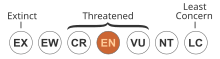
| Conservation status | |
| | |
| CITES Appendix I (CITES)[two] | |
Scientific classification  | |
| Kingdom: | Animalia |
| Phylum: | Chordata |
| Class: | Mammalia |
| Gild: | Primates |
| Suborder: | Haplorhini |
| Infraorder: | Simiiformes |
| Family unit: | Cercopithecidae |
| Genus: | Macaca |
| Species: | M. sylvanus[1] |
| Binomial name | |
| Macaca sylvanus[1] (Linnaeus, 1758)[3] | |
 | |
| Barbary macaque range | |
| Synonyms[four] | |
| Simia sylvanus Linnaeus, 1758 | |
The Barbary macaque (Macaca sylvanus), likewise known as Barbary ape or magot, is a macaque species native to the Atlas Mountains of Algeria and Morocco, forth with a small introduced population in Gibraltar.[2]

Skull and brain, as illustrated in Gervais' Histoire naturelle des mammifères
The Barbary macaque is of particular interest because males play an atypical role in rearing young. Because of uncertain paternity, males are integral to raising all infants. More often than not, Barbary macaques of all ages and sexes contribute in alloparental intendance of young.[5]
The nutrition of Barbary macaque consists primarily of plants and insects and they are found in a diversity of habitats. Males live to around 25 years onetime while females may live upwards to 30 years.[half-dozen] [seven] As well humans, they are the but costless-living primates in Europe. Although the species is commonly referred to as the "Barbary ape", the Barbary macaque is actually a true monkey. Its name refers to the Barbary Coast of Northwest Africa.
The population of the Barbary macaques in Gibraltar is the simply i outside Northern Africa and the only population of wild monkeys in Europe. Barbary macaques were once widely distributed in Europe, as far north every bit Norfolk, England, from the Zanclean to the Belatedly Pleistocene.[8] Almost 300 macaques live on the Rock of Gibraltar. This population appears to be stable or increasing, while the North African population is declining.[2]
History, taxonomy, and phylogeny [edit]
The Barbary macaque is start described in scientific literature by Aristotle in the 4th century BCE work History of Animals. He writes of an ape, " Πίθηκος " (), with "arms similar a man, just covered with hair", "feet [which] are exceptional in kind ... like big hands", and "a tail as small equally small can exist, but a sort of indication of a tail". Information technology is likely that Galen (129–c.216) dissected the Barbary macaque in the 2nd century CE, presuming the internal construction to be the aforementioned equally a human. Such was the authority of his work, some mistakes he fabricated were not corrected until Andreas Vesalius (1514–1564) proved otherwise over a thousand years later on.[ix] The Barbary macaque was included in the group Simia past Conrad Gessner in his 1551 work Historia Animalium,[nine] a name which he claimed was already in apply past the Greeks.[10] Gessner'due south Simia was afterward used as one of Carl Linnaeus' four primate genera when he published Systema Naturae in 1758. Linnaeus proposed the scientific name Simia sylvanus for the Barbary macaque.[iii] During the adjacent 150 years primate taxonomy was subject area to great changes and the Barbary macaque was placed in over thirty unlike taxa.[7] The defoliation over the use of Simia became and then neat that the International Commission on Zoological Classification (ICZN) suppressed its employ in 1929.[x] [7] This meant the Barbary macaque was placed in the next oldest genus assigned to information technology, Macaca, described by Bernard Germain de Lacépède in 1799.[7]
Phylogeny [edit]
The Barbary macaque is the nearly primitive macaque species, pregnant it is genetically closest to the ancestral form of all macaques.[eleven] [12] Phylogenetic and molecular analyses show it is a sister group to all macaque species in Asia. The results of a phylogenetic analysis testify that the chromosomes of Barbary macaque resemble those of the rhesus macaque with the exception of chromosomes one, iv, nine, and sixteen. It was also discovered that chromosome 18 the Barbary macaque is homologous to chromosome 13 in humans.[7]
Polymerase concatenation reaction studies have found Alu element insertions, small pieces of genetic code in genomes, tin can infer primate phylogenetic relationships. Using this method the phylogenetic relationship of ten species within the genus Macaca has been resolved, showing the Barbary macaque to be a sister group to all other macaques.[11]
| Phylogeny of ten species of Macaca [xi] | ||||||||||||||||||||||||||||||||||||||||||||||||||||||||||||||||||||||||
|---|---|---|---|---|---|---|---|---|---|---|---|---|---|---|---|---|---|---|---|---|---|---|---|---|---|---|---|---|---|---|---|---|---|---|---|---|---|---|---|---|---|---|---|---|---|---|---|---|---|---|---|---|---|---|---|---|---|---|---|---|---|---|---|---|---|---|---|---|---|---|---|---|
|
Fossil record [edit]
Barbary macaque fossils take been found across Europe, from the Atlantic Body of water to the Blackness Sea, dating from the Early on Pliocene to the Belatedly Pleistocene, assigned to various subspecies including M. southward. sylvanus, M. due south. pliocena and G. s. florentina. The insular dwarf 1000. majori owned to Sardinia-Corsica during the Early Pleistocene, unremarkably considered to have derived from M. sylvanus, is generally considered a singled-out species. Remains from Norfolk, England, dating to the Middle Pleistocene, at 53 degrees latitude, are amid the northernmost records of primates. The youngest known remains of Barbary macaques in Europe are from Hunas, Bavaria, Frg, dated to sometime between 85 and xl,000 years ago. The distribution of Barbary macaques in Europe was likely strongly controlled by climate, only extending into Northern Europe during interglacial intervals.[8]
Concrete description [edit]
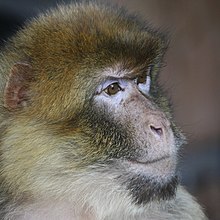


The Barbary macaque has a dark pink confront with a stake vitrify to golden brown to grey pelage and a lighter underside. The color of mature adults changes with ages.[thirteen] [7] In adults and subadults the fur on the dorsum is variegated stake and dark which is due to banding on individual hairs. In jump to early summertime, as the temperatures rise, the developed macaques moult their thick winter fur. The species shows sexual dimorphism with males larger than females. The mean head-body length is 55.7 cm (21.ix in) in females and 63.4 cm (25.0 in) in males. The boneless vestigial tail is greatly reduced compared with other macaque species and, if non absent, measures 4–22 mm (0.xvi–0.87 in). Males may have a more prominent tail, though information is scarce.[7] The boilerplate body weight is 9.9–11 kg (22–24 lb) in females and xiv.5–16 kg (32–35 lb) in males.[7] [xiv]
Similar all Old World monkeys the Barbary macaque well-developed sitting pads (ischial callosities) on its rear.[xiv] Females showroom an exaggerated anogenital swelling,[15] [16] which increases in size during heat.[17] [18] Information technology has cheek pouches and high-crowned bilophodont molars (molars with two ridges); the third tooth is elongated.[14] The diploid chromosome number of the Barbary macaque is 42, like other members of the Quondam World monkey tribe Papionini.[7]
Distribution and habitat [edit]
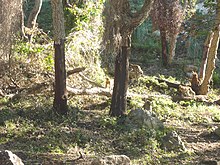
The Barbary macaque is the only macaque species found exterior Asia, and only African primate that survives north of the Sahara Desert.[13] [2] It lives mainly in fragmented areas of the Rif and the Center and Loftier Atlas mountain ranges of Morocco and the Grande and Petite Kabylie mountain region of Algeria. It has been recorded at altitudes of 400–2300 metres, though it seems to prefer higher elevations. The Moroccan and Algerian populations are around 700 km (430 mi) autonomously, although the gap was smaller during the Holocene.[vii]
Barbary macaques also occur in the British Overseas Territory of Gibraltar at the southern tip of Europe's Iberian Peninsula. Spanish historian from Gibraltar Alonso Hernández del Portillo noted in the early 17th century that the macaques had been present "from time immemorial".[19] Most likely, the Moors introduced macaques from Northward Africa to Gibraltar during the Middle Ages.[xx] During World War 2, British Prime Government minister Winston Churchill ordered for more Barbary macaques to exist introduced to Gibraltar to contrary population declines.[19] Today, there are effectually 300 Barbary macaques in Gibraltar.[2]
Information technology can live in a multifariousness of habitats, such as cedar, fir, and oak forests, grasslands, thermophilous scrub, and rocky ridges full of vegetation. The climate is Mediterranean and has seasonal extremes of temperature.[7] [thirteen] In Morocco, most Barbary macaques inhabit Atlas cedar (Cedrus atlantica) forests, but this could reverberate the nowadays habitat availability rather than a specific preference for this habitat.[7] In Algeria, the Barbary macaque is found mainly in Grande and Petite Kabylie, ranges that form function of the Tell Atlas mountain chain, only there is also an isolated population in Chréa National Park.[21] [2] It is found in mixed cedar and holm oak forests, humid Portuguese and cork oak forests, and scrub-covered gorges.[21]
Fossil bear witness indicates the species inhabited Southern Europe and all of N Africa. Historically, it was found beyond North Africa from Libya to Morocco.[2] A Tunisian population was mentioned in the works of aboriginal Greek author Herodotus (ca. 484–425 BCE), indicating the species has get extinct there within the last two,500 years.[7]
Behaviour and ecology [edit]
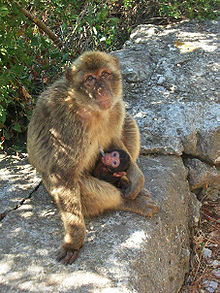
Female person Barbary macaque with young suckling
The Barbary macaque is gregarious, forming mixed groups of several females and males. Troops tin can have x to 100 individuals and are matriarchal, with their hierarchy adamant by lineage to the lead female.[22] Unlike other macaques, the males participate in rearing the young.[22] Males may spend a considerable amount of time playing with and training infants. In this way, a potent social bond is formed betwixt males and juveniles, both the male person'southward own offspring and those of others in the troop. This may be a outcome of selectivity on the part of the females, who may prefer highly parental males.[5]
The mating season runs from November through March. The gestation period is 147 to 192 days, and females usually have only one offspring per pregnancy. Females rear twins in rare instances. Offspring reach maturity at iii to iv years of historic period, and may live for 20 years or more.[23]
Training other Barbary macaques leads to lower stress levels for the individuals that do the grooming.[24] While stress levels practice not appear to be reduced in animals that are clean-cut, grooming more individuals leads to even lower stress levels; this is a benefit that might outweigh the costs to the groomer, which include less time to participate in other activities such as foraging. The mechanism for reducing stress may be explained by the social relationships (and support) that are formed by grooming.[24]
Male Barbary macaques interfere in conflicts and grade coalitions with other males, commonly with related males rather than with unrelated males. These relationships propose that males practise then in order to indirectly increase their ain fitness. Furthermore, males grade coalitions with closely related kin more often than they do with distantly related kin.[25] These coalitions are not permanent and may change oftentimes as male ranking within the grouping changes. Although males are more likely to class coalitions with males who have helped them in the by, this is non as important as relatedness in determining coalitions.[25] Males avoid alien with higher ranking males and will more frequently form coalitions with the higher ranking male person in a conflict.[25] Close group of males occur when infant Barbary macaques are present. Interactions between males are commonly initiated when a male presents an infant macaque to an adult male who is not caring for an infant, or when an unattached male person approaches males who are caring for infants. This behaviour leads to a blazon of social buffering, which reduces the number of antagonistic interactions among males in a group.[22]
An open up rima oris display by the Barbary macaque is used most unremarkably by juvenile macaques equally a sign of playfulness.[26]
Alarm calls [edit]
The main purpose of calls in Barbary macaques is to warning other grouping members to possible dangers such every bit predators. Barbary macaques can discriminate calls past individuals in their ain group from those past individuals in other groups of conspecific macaques. Neither genetic variation nor habitat differences are likely causes of acoustic variation in the calls of different social groups. Instead, minor variations in acoustic structure amongst groups similar to the song accommodation seen in humans are the likely cause. Withal, audio-visual characteristics such as pitch and loudness are varied based on the vocalizations of individuals they acquaintance with, and social situations play a role in the acoustic structure of calls.[27] [28]
Barbary macaque females have the power to recognize their own offspring'due south calls through a diversity of audio-visual parameters. Because of this, infant calls exercise not have to differ dramatically for mothers to be able to recognize their own infant's telephone call. Mothers demonstrate different behaviours on hearing the calls of other infant macaques as opposed to the calls of their own offspring. More parameters for vocalizations lead to more reliable identification of calls in both infants and in adult macaques so it is not surprising that the same audio-visual characteristics that are heard in babe calls are also heard in adult calls.[29]
Mating [edit]
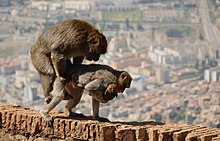
Although Barbary macaques are sexually agile at all points during a female's reproductive cycle, male Barbary macaques make up one's mind a female'due south about fertile period by sexual swellings on the female.[xxx] Mating is most common during a female person's virtually fertile period. The swelling size of the female reaches a maximum around the fourth dimension of ovulation, suggesting that size helps a male predict when he should mate. This is further supported by the fact that male person ejaculation peaks at the same time that female sexual swelling peaks. Alter in female person sexual behaviour around the time of ovulation is bereft to demonstrate to the male that the female person is fertile. The swellings, therefore, appear necessary for predicting fertility.[eighteen]
Barbary macaque females differ from other nonhuman primates in that they often mate with a bulk of the males in their social group. While females are active in choosing sexual associations, the mating behaviour of macaque social groups is not entirely determined by female person choice.[30] These multiple matings by females decrease the certainty of paternity of male Barbary macaques and may lead them to intendance for all infants within the group. For a male to ensure his reproductive success, he must maximize his fourth dimension spent effectually the females in the group during their fertile periods. Injuries to male macaques peak during the fertile menses, which points to male-male competition as an important determinant of male reproductive success.[30] Non allowing a female to mate with other males, however, would exist plush to the male, since doing so would not allow him to mate with more females.[30]
Parenting [edit]

Closeup of the face of a juvenile in Gibraltar
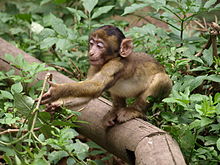
A young at the Montagne Des Singes, Alsace
Unlike other macaques where almost parental care comes from the mother, Barbary macaques from all age and sex activity groups participate in alloparental intendance of infants. Male care of infants has been of detail interest to research considering loftier levels of care from males are uncommon in groups where paternity is highly uncertain. Males even human activity as true alloparents of infant macaques by conveying them and caring for them for hours at a time every bit opposed to simply demonstrating more casual interactions with the infants. Female social status plays a role in female alloparental interactions with infants. College-ranking females accept more than interactions, whereas younger, lower-ranking females have less access to infants.[5]
Nutrition [edit]
The diet of the Barbary macaque consists of a mixture of plants and insect prey. It consumes a large diversity of gymnosperms and angiosperms. Almost every part of the plant is eaten, including flowers, fruits, seeds, seedlings, leaves, buds, bark, gum, stems, roots, bulbs, and corns. Common prey caught and consumed past Barbary macaques are snails, earthworms, scorpions, spiders, centipedes, millipedes, grasshoppers, termites, h2o striders, scale insects, beetles, collywobbles, moths, ants, and even tadpoles.[7]
Barbary macaques can cause major harm to the trees in their prime habitat, the Atlas cedar forests in Kingdom of morocco. Since deforestation in Morocco has become a major ecology problem in recent years, research has been conducted to determine the cause of the bawl stripping behaviour demonstrated by these macaques. Cedar copse are likewise vital to this population of Barbary macaques equally an expanse with cedars can support a much higher density of macaques than one without them. A lack of a h2o source and exclusion of monkeys from water sources are major causes of cedar bark stripping behaviour in Barbary macaques. Density of macaques, even so, is less correlated with the behaviour than the other causes considered.[31]
Predators [edit]
Their main predators are leopards, eagles (golden eagles may only predate on cubs, since they are not morphologically adapted to hunt primates; other birds of prey that exercise kill monkeys, like the crowned eagle, live in more than southern areas of Africa),[32] and domestic dogs.[7] The arroyo of eagles and domestic dogs is known to arm-twist an alarm call response.[7]
Threats [edit]

19th century analogy
Wild populations of Barbary macaques take suffered a major decline in recent years to the indicate of being declared an endangered species on the IUCN Red List since 2008. The Barbary macaque is threatened by fragmentation and degradation of forest habitat and poaching for the illegal pet trade, and it is killed in retaliation for raiding crops.[ii] [33]
Spain is the master entry bespeak in Europe. Today, no accurate data exist on the location and number of individuals out of their habitat. An unknown number of individuals is included in zoological collections, at other institutions, in individual hands, in storage, or waiting to be relocated to appropriate destinations.[2]
The habitat of the Barbary macaque is under threat from increased logging activeness.[34] Local farmers view the monkeys as pests, and engage in extermination of the species. In one case mutual throughout northern Africa and southern Europe, only an estimated 12,000 to 21,000 Barbary macaques are left in Morocco and Algeria. In one case, their distribution was much more all-encompassing, reaching Tunisia and Libya. Their range is no longer continuous, with only isolated areas of range remaining. During the Pleistocene, this species inhabited the Mediterranean coasts and Europe, reaching Italy, Republic of hungary, Spain, Portugal, and France, and as far north as Germany and the British Isles.[35] The species decreased with the arrival of the Water ice Age, becoming extinct in the Iberian Peninsula 30,000 years agone.[36] [ clarification needed ]
The Barbary macaque is threatened by habitat loss, overgrazing, and illegal capture. In Morocco, tourists interact with Barbary macaques in many regions. Data collected in the interviews with inhabitants in the Loftier Atlas of Morocco indicated that the capture of macaques occurs in these regions. Conflict between local people and wild macaques is 1 of the greatest challenges to Barbary macaque conservation in Morocco. The chief threats to the survival of Barbary macaques in this region take been found to be habitat destruction and the impact of livestock grazing, but problems of conflict with inhabitants are besides increasing due to ingather raiding and the illegal capture of macaques. Human being–macaque conflict is mainly due to ingather raiding. In the High Atlas of Kingdom of morocco, macaques attract a large number of tourists every year, and they are favoured for their potential benefits to tourism. In addition, macaques have some ecological roles; for example, they are the predators of several destructive insects and pests of plants and participate in seed dispersal in many found species.[37] [38] [39] [40] [41] [42]
In the Central High Atlas, the Barbary macaque occurs in relatively small and fragmented areas restricted to the primary valleys at altitudes of 700–2,400 m. In a 2013 study, researchers reported that they institute Barbary macaques in relatively small-scale and fragmented habitats in ten sites, and that the species no longer occurred in four localities. This could exist attributed to habitat degradation, hunting activities, the affect of livestock grazing, and disturbance by people. As deforestation for agriculture and overgrazing continues, the remaining forest becomes increasingly fragmented. Consequently, the Barbary macaque is now restricted to small, fragmented relict habitats.[37]
Human use and tourism [edit]
Many of the mistaken ideas near homo anatomy independent in the writings of Galen are apparently due to his use the Barbary macaque, the only anthropoid available to him, in dissections.[43] Strong cultural taboos of his fourth dimension prevented his performing any actual dissections of man cadavers, even in his role as physician and teacher of physicians.[44]
Macaques in Morocco are frequently used every bit photo props, despite their protected condition.[45] Tourists are encouraged to accept photos with the animals for a fee. Macaques are also sold every bit pets in Morocco and Algeria, and exported to Europe to be used as pets and fighting monkeys, both in physical marketplaces and online.[45] [46]
Tourists interact with wild monkeys beyond the world, and in some situations, tourists may be encouraged to feed, photograph, and touch the monkeys. Although tourism has the potential to bring in money towards conservation goals and provides an incentive for the protection of natural habitats, shut proximity and interactions with tourists can also accept significant psychological impacts on the Barbary macaques. Fecal samples and stress-indicating behaviours, such equally abdomen scratching, bespeak that the presence of tourists has a negative impact on the macaques. Human activities such as taking photographs crusade the animals stress, mayhap considering the people come also close to the animals and make prolonged eye contact (a sign of aggression in many primates). Macaques that live in areas close to human contact have more parasites and lower overall health than those that alive in wilder environments, at least in function due to the unhealthy diets they receive as a consequence of feeding from humans.[47] [48]
Several groups of Barbary macaques can be establish in tourist sites, where they are affected by the presence of visitors providing food to them. Researchers comparison two such groups in the central High Atlas mountains in 2008 found that the tourist group of Barbary macaques spent significantly more fourth dimension engaged in resting and aggressive behaviour, and foraged and moved significantly less than the wild group. The tourist group spent significantly less time per twenty-four hour period feeding on herbs, seeds, and acorns than the wild grouping. Human food deemed for 26% of the daily feeding records for the tourist grouping, and 1% for the wild-feeding group.[39] Scientists who collected information on the seasonal activity budget and nutrition composition of the endangered Barbary macaque group inhabiting a tourist site in Morocco institute that activeness budgets and nutrition of the study group varied markedly amid seasons and habitats. The percentage of daily time spent in foraging and moving was everyman in spring, and the daily time spent in resting was highest in spring and summer. The time budget devoted to aggressive brandish was highest in jump than the other 3 seasons. In that location is an increase in the daily feeding time spent eating flowers and fruits in summer, seeds, acorns, roots and barks in winter and fall, herbs in jump and summer, and a articulate increase in consumption of the human food in jump.[38] The tourist and the wild groups did not differ in the proportion of daily records devoted to terrestrial feeding, but the tourist group spent a significantly lower percentage of daily records in terrestrial foraging, moving and resting, while performing more terrestrial aggressive displays more than the wild group. There was no significant difference betwixt the two groups in the proportion of terrestrial feeding records spent eating fruits; only the tourist group had lower daily percentages of terrestrial feeding on leaves, seeds and acorns, roots and barks, and herbs, while it spent higher daily percentages of terrestrial feeding on homo food.[twoscore]
At that place is evidence that Barbary macaques were traded or possibly given as diplomatic gifts equally long ago as the Iron Age. Their remains have been establish in such sites as Emain Macha in Ireland, dating to no later than 95 BC; an Atomic number 26 Age hillfort, the Titelberg in Luxembourg; and two Roman sites in U.k..[49]
See also [edit]
- Djebel Babor Nature Reserve
- Trentham Monkey Woods
References [edit]
- ^ Groves, C. P. (2005). "Species Macaca sylvanus". In Wilson, D. E.; Reeder, D. Thousand (eds.). Mammal Species of the Globe: A Taxonomic and Geographic Reference (tertiary ed.). Johns Hopkins University Press. p. 164. ISBN978-0-8018-8221-0. OCLC 62265494.
- ^ a b c d e f chiliad h i j Wallis, J.; Benrabah, M.E.; Pilot, M.; Majolo, B.; Waters, Due south. (2020). "Macaca sylvanus". IUCN Red List of Threatened Species. 2020: east.T12561A50043570. doi:10.2305/IUCN.Great britain.2020-ii.RLTS.T12561A50043570.en . Retrieved 17 January 2022.
- ^ a b Linnaeus, C. (1758). "Simia sylvanus". Systema naturæ per regna tria naturæ, secundum classes, ordines, genera, species, cum characteribus, differentiis, synonymis, locis. Vol. I (Decima, reformata ed.). Holmiæ: Laurentii Salvii. p. 25.
- ^ "Macaca sylvanus". Integrated Taxonomic Information System. Retrieved 22 September 2021.
- ^ a b c Small-scale, M. F. (1990). "Alloparental behaviour in Barbary macaques, Macaca sylvanus". Animal Behaviour. 39 (2): 297–306. doi:10.1016/s0003-3472(05)80874-seven. S2CID 53192425.
- ^ Rathke, E. -Thou.; Berghänel, A.; Bissonnette, A.; Ostner, J.; Schülke, O. (2017). "Historic period-dependent change of coalitionary strategy in male Barbary macaques". Primate Biological science. iv (one): ane–seven. doi:x.5194/pb-4-1-2017. PMC7041515. PMID 32110686.
- ^ a b c d due east f g h i j yard l m n o p Fooden, J. (2007). Systematic review of the Barbary macaque, Macaca sylvanus (Linnaeus, 1758). New series No. 113. Chicago: Field Museum of Natural History.
- ^ a b Elton, Sarah; O'Regan, Hannah J. (2014). "Macaques at the margins: the biogeography and extinction of Macaca sylvanus in Europe". Quaternary Science Reviews. 96: 117–130. doi:10.1016/j.quascirev.2014.04.025.
- ^ a b McDermott, Westward. C. (1938). The apes in antiquity. Baltimore: Johns Hopkins University Press. pp. 88–100.
- ^ a b Stiles, Charles Wardell; Orleman, Mabelle Blanche (1927). The nomenclature for man, the chimpanzee, the orang-utan, and the Barbary ape. U.S. Government Press Office. pp. 3–x.
- ^ a b c Li, Jing; Han, Kyudong; Xing, Jinchuan; Kim, Heui-Soo; Rogers, Jeffrey; Ryder, Oliver A.; Disotell, Todd; Yue, Bisong; Batzer, Marker A. (2009). "Phylogeny of the macaques (Cercopithecidae: Macaca) based on Alu elements". Gene. 448 (two): 242–249. doi:x.1016/j.gene.2009.05.013. PMC2783879. PMID 19497354.
- ^ Hodges, J. K.; Cortes, J. (2006). The Barbary macaque: biology, management and conservation. Nottingham, UK: Nottingham University Press.
- ^ a b c Waters, Southward. Southward. (2013). "Family Cercopithecidae: Old Earth monkeys". In Mittermeier, Russell A.; Rylands, Anthony B.; Wilson, Don E. (eds.). Handbook of the mammals of the world. Volume three. Primates. Barcelona: Lynx Edicions. pp. 550–639. ISBN978-84-96553-89-7.
- ^ a b c Fleagle, John G. (2013). Primate adaptation and evolution (3rd ed.). Amsterdam: Elsevier/Academic Press. ISBN9780123786326. OCLC 820107187.
- ^ Kuester, J.; Paul, A. (1984). "Female person reproductive characteristics in semifree-ranging Barbary macaques (Macaca sylvanus L. 1758)". Folia Primatologica. 43 (ii–3): 69–83. doi:10.1159/000156173. PMID 6519600.
- ^ Taub, D. M. (1978). "The Barbary macaque of N Africa". Oryx. 14 (iii): 245–253. doi:10.1017/S0030605300015581.
- ^ Möhle, U.; Heistermann, Thou.; Dittami, J.; Reinberg, V.; Hodges, J. Chiliad.; Hodges, J. Thou. (2005). "Patterns of anogenital swelling size and their endocrine correlates during ovulatory cycles and early pregnancy in free-ranging barbary macaques (Macaca sylvanus) of Gibraltar". American Periodical of Primatology. 66 (4): 351–368. doi:10.1002/ajp.20161. PMID 16104035. S2CID 19899619.
- ^ a b Brauch, Katrin; Pfefferle, Dana; Hodges, Keith; Möhle, Ulrike; Fischer, Julia; Heistermann, Michael (2007). "Female sexual behavior and sexual swelling size as potential cues for males to discern the female fertile stage in gratuitous-ranging Barbary macaques (Macaca sylvanus) of Gibraltar". Hormones and Beliefs. 52 (three): 375–383. doi:ten.1016/j.yhbeh.2007.06.001. PMID 17644098. S2CID 30650507.
- ^ a b Nosowitz, D. (2019). "The Curious Instance of the Last 'Wild' Monkeys in Europe". Atlas Obscura . Retrieved 2022-04-03 .
- ^ Jackson, W.One thousand.F. (1987). "one. Mons Calpe to Djebel Musa". The Rock of the Gibraltarians – A History of Gibraltar. Fairleigh Dickinson Academy Press. p. 28. ISBN0-8386-3237-8.
- ^ a b Taub, David Milton (1977). "Geographic distribution and habitat diverseness of the Barbary macaque Macaca sylvanus 50.". Folia Primatologica. 27 (2): 108–133. doi:ten.1159/000155781.
- ^ a b c Deag, J. Thousand (1980). "Interactions between males and unweaned Barbary macaques: testing the agonistic buffering hypothesis". Behaviour. 75 (1): 54–lxxx. doi:10.1163/156853980x00564.
- ^ Kuester, J. (1999). "Male migration in Barbary macaques at Affenberg Salam". International Journal of Primatology. 20 (1): 85–106. doi:10.1023/A:1020536317646. S2CID 43112228.
- ^ a b Shutt, Yard.; MacLarnon, A.; Heistermann, G.; Semple, S. (2007). "Grooming in Barbary macaques: meliorate to requite than to receive?". Biology Messages. 3 (three): 231–233. doi:ten.1098/rsbl.2007.0052. PMC2464693. PMID 17327200.
- ^ a b c Widdig, A.; Streich, W. J.; Tembrock, G. (2000). "Coalition germination among male Barbary macaques (Macaca sylvanus)". American Journal of Primatology. 50 (one): 37–51. doi:ten.1002/(sici)1098-2345(200001)50:1<37::aid-ajp4>three.3.co;2-v. PMID 10588434.
- ^ Preuschoft, S. (1992). ""Laughter" and "grin" in Barbary macaques (Macaca sylvanus)". Ethology. 91 (3): 220–236. doi:10.1111/j.1439-0310.1992.tb00864.x.
- ^ Fischer, J.; Hammerschmidt, 1000.; Todt, D. (1998). "Local variation in Barbary macaque shrill barks". Fauna Behaviour. 56 (3): 623–629. doi:ten.1006/anbe.1998.0796. PMID 9784211. S2CID 6947829.
- ^ Fischer, J.; Hammerschmidt, K. (2002). "An overview of the Barbary macaque, Macaca sylvanus, vocal repertoire". Folia Primatologica. 73 (one): 32–45. doi:10.1159/000060417. PMID 12065939. S2CID 9791964.
- ^ Hammerschmidt, K.; Todt, D. (1995). "Individual differences in vocalisations of immature Barbary macaques (Macaca sylvanus): a multi-parametric analysis to place disquisitional cues in acoustic signalling". Behaviour. 132 (5): 381–399. doi:x.1163/156853995x00621.
- ^ a b c d Kuester, J.; Paul, Andreas (1992). "Influence of male competition and female mate pick on male person mating success in Barbary macaques". Behaviour. 120 (three/4): 192–216. doi:10.1163/156853992x00606. JSTOR 4535008.
- ^ Ciani, A. C.; Camperio, A.; Martinoli, L.; Capiluppi, C.; Arahou, M.; Mouna, M. (2001). "Effects of h2o availability and habitat quality on barkstripping behavior in Barbary macaques". Conservation Biology. fifteen (1): 259–265. doi:10.1111/j.1523-1739.2001.99019.10. S2CID 86080812.
- ^ Bautista, J. (2018). "Golden eagles (Aquila chrysaetos) as potential predators of Barbary macaques (Macaca sylvanus) in northern Morocco: evidences of predation". Go-South Balderdash. 15n: 172–179.
- ^ van Uhm, D. P. (2016). "Monkey business organization: the illegal trade in Barbary macaques". Journal of Trafficking, Organized Crime and Security. 2 (1): 36–49. hdl:1874/358227.
- ^ van Lavieren, Eastward.; Wich, Due south. A. (2010). "Pass up of the endangered Barbary macaque in the cedar woods of the Middle Atlas Mountains, Morocco". Oryx. 44 (i): 133–138. doi:10.1017/s0030605309990172.
- ^ Von Segesser, F.; Menard, North.; Gaci, B.; Martin, R. D. (1999). "Genetic differentiation within and betwixt isolated Algerian subpopulations of Barbary macaques: show from microsatellites". Molecular Ecology. 8 (three): 433–442. doi:10.1046/j.1365-294x.1999.00582.ten. PMID 10199007. S2CID 23657621.
- ^ O'Reagan, H. (2008). "The Iberian Peninsula- corridor or cul-de-sac? Mammalian faunal change and possible routes of dispersal in the last 2 one thousand thousand years". 4th Scientific discipline Reviews. 27 (23–24): 2136–2144. Bibcode:2008QSRv...27.2136O. doi:10.1016/j.quascirev.2008.08.007.
- ^ a b El Alami, A.; Van Lavieren, E.; Aboufatima, R.; Chait, A. (2013). "A survey of the endangered Barbary macaque Macaca sylvanus in the fundamental High Atlas Mountains, Morocco". Oryx. 47 (three): 451–456. doi:10.1017/s0030605311001463.
- ^ a b El Alami, A.; Chait, A. (2012). "Seasonal variation in activity budget and diet of the endangered Macaca sylvanus in the tourist valley of Ouzoud, Key High Atlas, Kingdom of morocco". Mammalia. 76: 245–250. doi:10.1515/mammalia-2011-0054. S2CID 87795900.
- ^ a b El Alami, A.; Van Lavieren, E.; Aboufatima, R.; Chait, A. (2012). "Differences in activity budgets and diet between semiprovisioned and wild-feeding groups of the endangered Barbary macaque (Macaca sylvanus) in the Primal Loftier Atlas Mountains, Kingdom of morocco". American Journal of Primatology. 74 (three): 210–216. doi:ten.1002/ajp.21989. PMID 24006539. S2CID 18223816.
- ^ a b El Alami, A.; Chait, A. (2013). "Comparison of the terrestriality of Barbary macaques (Macaca sylvanus) between tourist and wild sites in the region of Ouzoud, Morocco". Mammalia. 78 (4): 539–542. doi:10.1515/mammalia-2013-0061. S2CID 87021869.
- ^ El Alami, A.; Chait, A. (2014). "Distribution of the endangered Barbary macaque and human-macaque interaction in the tourist region of Ouzoud, central High Atlas of Morocco". African Journal of Environmental. 53 (3): 375–377. doi:10.1111/aje.12191.
- ^ El Alami, A.; Chait, A. (2015). "Roles of tourism in the local people opinion regarding human-macaque disharmonize in the central High Atlas, Morocco". Revue de Primatologie. 7: one–seven.
- ^ Ustun, C. (2004). "Galen and his anatomic eponym: vein of Galen". Clinical Anatomy. 17 (half dozen): 454–457. doi:10.1002/ca.20013. PMID 15300863.
- ^ Arnold, T. (1932). "Police force enforcement: an attempt at social dissection". The Yale Law Journal. 42 (one): one–24. doi:10.2307/791414. JSTOR 791414.
- ^ a b Nijman, V.; Bergin, D.; van Lavieren, E. (2015). "Barbary macaques exploited equally photo-props in Marrakesh'south penalisation foursquare". SWARA (July–September ed.). pp. 38–41.
- ^ Bergin, D.; Atoussi, S.; Nijman, V. (2017). "Online trade of Barbary macaques Macaca sylvanus in People's democratic republic of algeria and Morocco" (PDF). Biodiversity and Conservation. 27 (2): 531–534. doi:ten.1007/s10531-017-1434-5. S2CID 41616038.
- ^ "Tourists upset Morocco Barbary macaque monkeys". BBC.
- ^ "Monkeys and tourism – a toll to pay". Archived from the original on 25 March 2015.
- ^ Lynn, C. (2003). Navan Fort: archæology and myth. Bray, Co. Wicklow, Republic of ireland: Wordwell. pp. 49–50. ISBN9781869857677.
External links [edit]
- ARKive - images and movies of the Barbary macaque (Macaca sylvanus)
- Chisholm, Hugh, ed. (1911). . Encyclopædia Britannica (11th ed.). Cambridge University Press.
Source: https://en.wikipedia.org/wiki/Barbary_macaque
0 Response to "What Region Is Home to Europes Last Wild Monkeys?"
Post a Comment